What is Process?
Process 進程,是作業系統中用來管理工作的單位之一,可以把他想成一個國家中的個人,而 Kernel 就是國家的管理機構,實際上 Kernel 也是進程。與 Process 相比,Program 則是指存在硬碟上的執行檔,把 Program 載入記憶體並執行機器碼就叫 Process,所以 Process 是 Program 的實例(instance)。
系統為了管理 Process ,會給每個 Process 指派一個唯一的 ID(簡稱 PID),除此之外 Process 還會有自己的 Program Counter、State、Memory Layout、File Descriptor Table 等等,這些都存在一個叫做 Process Control Block (簡稱 PCB)的結構之中。 Linux 中定義的 PCB 叫做 task_struct ,細節可以到 /include/linux/sched.h 看,是一個長達數百行的結構。
struct task_struct {
    ...
    pid_t                 pid;           /* Task ID (Kernel 內部的任務標識符) */
    pid_t                 tgid;          /* Thread Group ID (User Space 看到的 POSIX PID) */
    struct task_struct __rcu *real_parent;/* 建立此進程的原始父進程 */
    struct task_struct __rcu *parent;     /* 目前接收終止狀態與訊號的父進程 (Orphan 時指向 PID 1) */
    struct list_head      children;      /* 子進程鏈表頭 (指向自己創立的所有子進程) */
    struct list_head      sibling;       /* 兄弟節點 (將自己掛載於父進程的 children 鏈表中) */

    unsigned int          __state;       /* 進程狀態 (TASK_RUNNING, TASK_INTERRUPTIBLE, EXIT_ZOMBIE 等) */
    int                   prio;          /* 動態優先權 (排程器計算 CPU 資源分配與 Context Switch 的依據) */
    int                   static_prio;   /* 靜態優先權 (基於 nice 值計算) */
    unsigned int          policy;        /* 排程策略 (如 SCHED_NORMAL, SCHED_FIFO, SCHED_RR) */

    struct mm_struct     *mm;            /* 虛擬記憶體描述符 (包含 text, data, heap, stack 與 page table) */
    struct mm_struct     *active_mm;     /* 實際使用的虛擬記憶體空間 (Kernel Thread 借用其他進程的 mm) */

    struct files_struct  *files;         /* 檔案描述符表 (File Descriptor Table,包含 stdin/stdout/stderr 陣列) */
    struct fs_struct     *fs;            /* 檔案系統環境 (包含當前工作目錄 pwd 與根目錄 root) */

    const struct cred __rcu *cred;       /* 安全憑證 (包含 Real/Effective/Saved UID 及 GID) */

    struct signal_struct *signal;        /* 共享信號描述符 (同一個進程內所有 thread 共享) */
    sigset_t              blocked;       /* 被遮罩/阻塞的信號集合 (Signal Mask) */
    sigset_t              pending;       /* 已發送但尚未處理的懸掛信號集合 */
    ...
};
Unix 提供了 getpid 來獲得當前 PID、getppid 來獲得父進程的 PID:
#include <unistd.h>
// Return: process ID of calling process
pid_t getpid(void);
// Return: the parent process ID of calling process
pid_t getppid(void);
一些有關進程的身份組的 syscall:
uid_t getuid(void); // return the real uid
uid_t geteuid(void); // return the effective uid
gid_t getgid(void); // return the real gid
gid_t getegid(void); // return the effective gid
Process Lifecycle
前面提到 Process 會有執行狀態,分別是 New、Ready、Running、Waiting、Terminated:
- New:The process is being created
- Running:The program is executed on a CPU
- Waiting:The process is waiting for some events to occur
- Ready:The process is waiting to be assigned to a CPU
- Terminated:The process has finished execution
從 Running -> Ready 或 Ready -> Running,在 CPU 上執行、等待發配給 CPU 的過程就叫做 Context Switching。舉例來說, Process A 執行一段時間後, Kernel 會把他的狀態存到 Process 1 的 PCB,接著從 Process B 的 PCB 中取出 Process B 的狀態,接著執行一段時間後再換人。
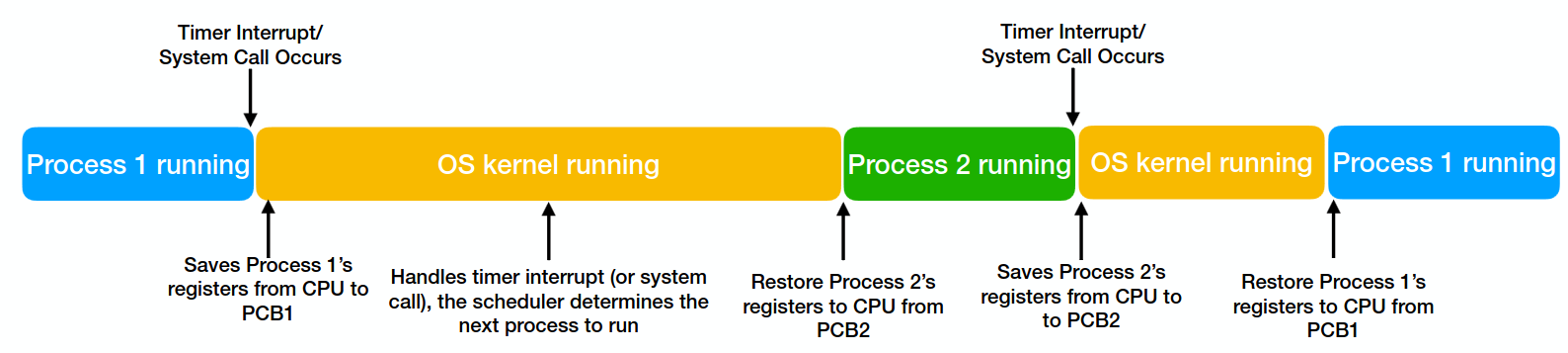
來源:SP2026Fall sp07-proc-control.pdf
exec & fork
假設我們正在撰寫一個 C 程式,希望它能夠執行 Linux 中的 ls 命令,列出目前目錄的檔案。最直覺的想法,可能是直接在程式中像在 shell 中呼叫 ls 一樣。事實上,Linux 確實提供了這樣的機制,也就是 exec 函式家族:
#include <unistd.h>
// All return -1 on error; no return on success
int execl(const char *pathname, const char *arg0, … /* (char *)0 */ );
int execv(const char *pathname, char *const argv[]);
int execle(const char *pathname, const char *arg0, … /* (char *)0, char *const envp[] */ );
int execve(const char *pathname, char *const argv[], char *const envp[]);
int execlp(const char *filename, const char *arg0, … /* (char *)0 */ );
int execvp(const char *filename, char *const argv[]);
int execvpe(const char *file, char *const argv[], char *const envp[]);
exec 函式家族的功能是以指定的 Program 取代目前進程,然後分配新的記憶體、暫存器等,但是進程本身的 PID 與父進程不會變,就像是把進程的外包裝留著,換掉內部的東西。
這些函式的功能大同小異,差別主要在於參數的傳遞方式,以及如何指定環境變數與搜尋執行檔。可以透過函式名稱中的字母來記憶:
l:個別傳入參數v:以陣列傳入參數,注意最後一個參數後必須加上NULLp:支援透過 PATH 搜尋執行檔(不用指定/bin/ls這類完整路徑),並將全域環境變數加入新程式的環境變數e:可以指定新程式的環境變數
比較常用的有execve與execvp。
環境變數只是一堆字串,如 {"A=1", "B=2", ...} ,可以用 getenv("VARIABLE_NAME") 找出 VARIABLE_NAME 的值:
#include <stdlib.h>
char* NAME = getenv("NAME");
if (NAME != NULL) printf("my name is %s\n", NAME);
舉例來說,讓程式執行 ls:
int main() {
    printf("Before execvp\n");
    char *args[] = {"ls", "-l", NULL};
    execvp("ls", args);
    printf("After execvp\n");
    return 1;
}
輸出:
$ gcc myls.c && ./a.out
Before execvp
total 20
-rwxrwxr-x 1 admin admin 16048 Oct 24 22:27 a.out
-rw-rw-r-- 1 admin admin   154 Oct 24 22:27 myls.c
因為execvp() 成功時,會以新的 Program 取代目前進程,所以 After execvp 並不會被輸出。雖然說原進程大部分的屬性都會消失,但是有些屬性,如未設定 FD_CLOEXEC 標籤的 FD 還會繼續保留。如果沒使用帶有 e 的 exec ,那麼環境變數也會保留。注意如果執行的是帶有 setuid/gid 的 Program,那麼進程的 Effective UID/GID 也會改變。
exec 後會保留的東西:
| 屬性 | 是否保留 |
|---|---|
| PID | Yes |
| Effective ID | Yes, unless suid/sgid is set on the executable |
| Real ID | Yes |
| Address Space | No |
| Open FDs | Yes, unless F_CLOEXEC is set |
| Current Working Directory | Yes |
| Environment Vars | Yes, unless e is part of exec. |
| POSIX File Locks | Yes |
exec 詳細的用法,以下程式都執行 ls -l:
char *argv[] = {"ls", "-l", NULL};
char *envp[] = {"YEAR=2026", "COURSE=SystemProgramming", "SEMESTER=Fall", NULL};

execl("/bin/ls", "ls", "-l", NULL);
execlp("ls", "ls", "-l", NULL);
execl("/bin/ls", "ls", "-l", NULL, envp);
execv("/bin/ls", argv);
execvp("ls", argv);
execve("/bin/ls", argv, envp);
用 exec 並不能真的創造一個新進程,所以 fork 就來了,非遲但到。
當一個行程呼叫 fork() 時,系統會建立一個新的進程,稱為子進程(child process);呼叫 fork() 的原始進程則稱為父進程(parent process)。在一般情況下,父進程與子進程會從 fork() 呼叫之後繼續執行。
#include <unistd.h>
// returns: 0 if in the child, process ID of child if in the parent, -1 on error
pid_t fork(void);
呼叫 fork 後,系統會把父進程的狀態複製給子進程(乾一直打成紫禁城)。此時需要透過 fork 的回傳值分辨目前執行的身份是 parent 還是 child。如果 fork 回傳大於 0 的值表示在 parent,回傳 0 表示在 child。fork 會失敗的原因通常是目前進程數量達到 Kernel 上限(4194304個),或每個使用者能擁有的進程數量達到上限(47812個)。
舉例來說:
int main() {
    if (fork() == 0) { // fork 後 child 會從判斷回傳值開始
        printf("Hello from child\n");
    } else {
        printf("Hello from parent\n");
    }
    return 0;
}
輸出:
$ gcc fork.c && ./a.out
Hello from parent
Hello from child
子進程與父進程的不同之處在於, fork 後的那一刻他們都有相同的 Memory Layout、Program Counter、Call Stack、File Descriptor Table、Environment Variables、Effective UID/GID 等等,這種情況叫做子進程「繼承」父進程的狀態(Inheritance)。
當然還是有些東西不會繼承,如:Threads、POSIX File Locks(用 fcntl 設定的鎖)、Nonblocking IO Tasks 等。
除此之外,他們也不會共用記憶體空間,舉例來說:
int main() {
    int x = 114514;
    if (fork() == 0) {
        x = 1919810;
        printf("child: x = %d\n", x);
    } else {
        printf("parent: x = %d\n", x);
    }
    return 0;
}
輸出:
parent: x = 114514
child: x = 1919810
不論 child 如何更改 x, parent 所讀到的還會是原本的值。因此,變數 x 會被複製一份到 child 的記憶體中, Linux 為了節省系統開銷,採用了 Copy-On-Write 機制,只有當資料真的需要被修改時,才建立一份獨立的副本,它讓作業系統不必在建立 child process 時,立刻複製 parent process 的所有記憶體內容。
在 fork 完成後,此時 parent 和 child 的虛擬記憶體會對應到同一個記憶體分頁,此時這個分頁會被設為唯讀,讓兩者暫時無法直接修改這個共用頁面。假設 child 要寫入時,就會觸發頁面錯誤(Page Fault),說明出了某些問題。
在系統確認完這次是一個合法的寫入後,就會配置一個新的實體記憶體頁面,並將 child 的虛擬記憶體映射改成指向新頁面,然後將兩邊的頁面都設為可寫入。
fork 的常用場景:
- 父進程與子進程同時執行不同部份的程式,常用在 server
- 程式想要執行其他 Program 時,搭配與
exec使用,如 shell
因為 CPU 會作排程,所以無法確定 parent 或 child 哪個先執行,所以最好的辦法,就是在父子進程間實作同步機制,給你做一個 Sleep 或 Pipe…。
fork 後是否繼承表:
| Item | Inherited? | Reason |
|---|---|---|
| Global variables | Yes | Part of the process’s memory |
| Local variables | Yes | Part of the process’s memory |
| Heap memory | Yes | Part of the process’s memory |
| Environment variables | Yes | Represented in the process’s memory |
| File descriptors | Yes | The child receives copies of the descriptor table entries |
| Current working directory | Yes | The child inherits the directory state |
| Signal mask | Yes | Explicitly inherited |
| Pending signals | No | The child’s pending-signal set starts empty |
| PID | No | The child receives a new PID |
| Parent PID | Different | The child’s PPID identifies its parent |
POSIX process-associated record locks (fcntl, F_SETLK) | No | Explicitly excluded from inheritance |
flock() locks on Linux | Shared | Parent and child descriptors refer to the same open file description |
| Threads | No, except the calling thread | Only the thread that called fork() exists in the child |
與 fork 很像的是 vfork:
#include <unistd.h>
// returns: 0 in child, process ID of child in parent, -1 on error
pid_t vfork(void);
fork 讓父、子進程擁有各自的記憶體空間;vfork 則暫時讓子進程在父進程的位址空間中執行,並暫停父進程,直到子進程呼叫 exec 系列函式或 _exit。vfork 的設計目的,是讓子進程可以快速呼叫 exec 執行另一個程式,免去了複製父進程程式碼、記憶體的開銷。不過,現在 fork 通常已實裝 COW 機制,因此 vfork() 的效能優勢不像早期那麼重要。
舉例:
pid_t pid = vfork(); // 父進程卡在這
if (pid == 0) {
    execve(path, argv, envp);
    _exit(127);
}
// 等 _exit 後父進程繼續執行_
如果子進程沒有呼叫 exec/_exit ,或者修改父進程變數、呼叫函式,皆屬於未定義行為(Undefined Behavior),無法預期什麼會發生。
舉例:
int x = 10;
pid_t pid = vfork();
if (pid == 0) {
    x = 20;
    _exit(0);
}
注意應該呼叫 _exit 來結束,不應該呼叫 exit 或 return 0,這些方式會清除 atexit 註冊的函式導致父進程結束的行為改變,即將介紹 _exit 。
因為 vfork 預設使用者大概會呼叫 exec ,所以可以省去先複製父進程 Program 再切換到 exec 的 Program 的開銷。可以說 vfork 的限制比 fork 多,且現在 fork 也優化了,一般情況下不建議用。
exit
#include <stdlib.h> (specified in ISO C)
void exit(int status);
void _Exit(int status);
#include <unistd.h> (specified in POSIX.1)
void _exit(int status);
exit 用來正常結束進程,也就是說會釋放資源,而 _exit/_Exit 不會。status 是結束狀態,常看到的 return 0 就是結束狀態 0,非零值代表不正常結束(執行錯誤等等),需要使用者自行解讀回傳值。
| 行為 | exit() | _Exit() | _exit() |
|---|---|---|---|
| 定義標準 | ISO C | ISO C(C99 起) | POSIX |
執行 atexit() 註冊的函式 | 是 | 否 | 否 |
刷新 stdio 緩衝區 | 是 | 否 | 否 |
關閉 stdio streams | 是 | 不執行標準 I/O 清理 | 不執行標準 I/O 清理 |
| 關閉進程的檔案描述符 | 是,經由終止程序 | 是,經由終止程序 | 是 |
| 終止進程 | 是 | 是 | 是 |
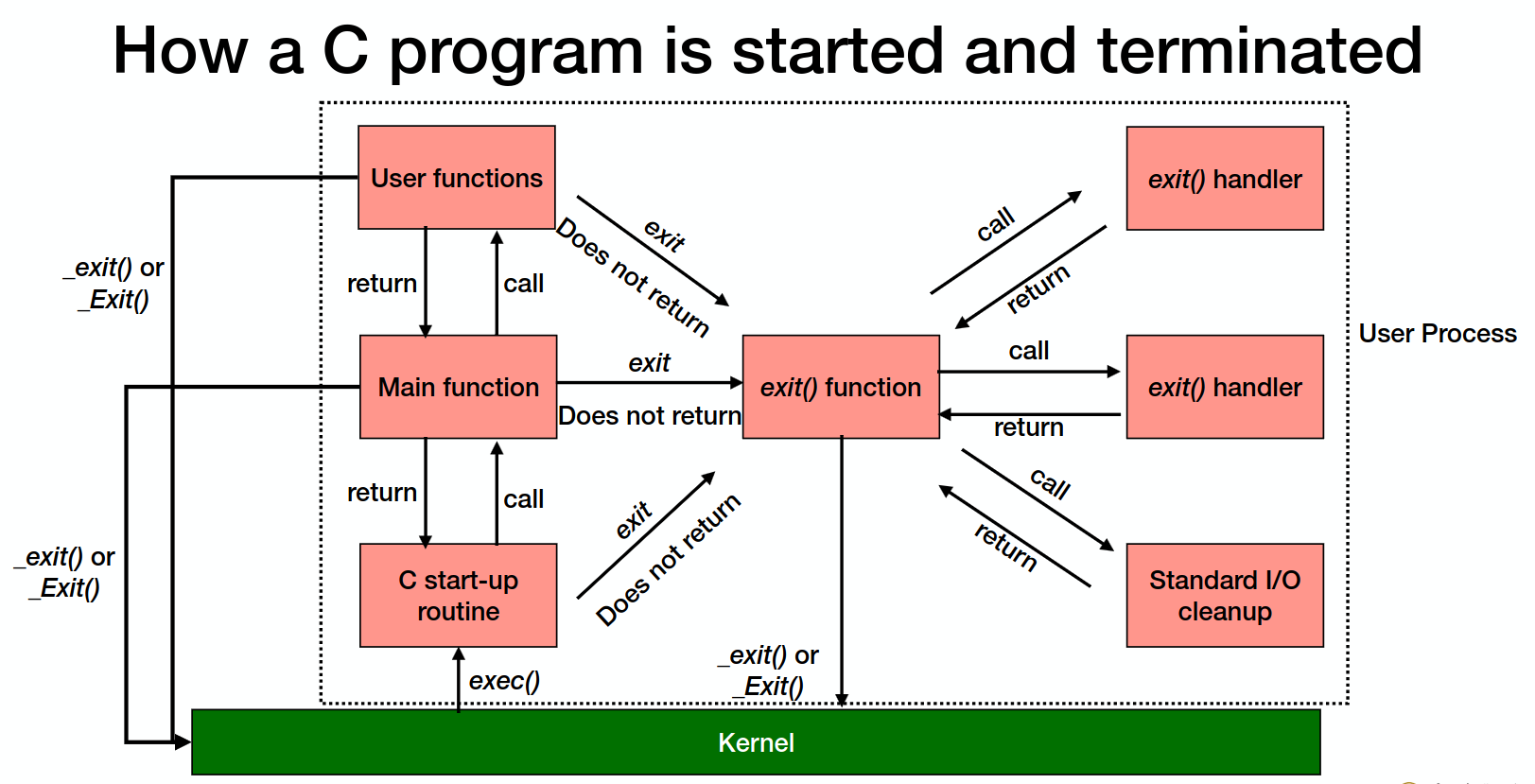
來源:SP2026Fall sp08-proc-control.pdf
#include <stdlib.h>
// Returns 0 if OK, nonzero on error
int atexit(void (*func)(void));
註冊一個函式 func,然後該函式會在 exit() 執行時執行。父進程註冊的 atexit 函式 fork 後會被繼承。
舉例:
static void exit_handler(void) {
    printf("All tasks done... Leaving...\n");
}
int main(void) {
	atexit(exit_handler);
	printf("Doing some tasks here...\n");
	return 0;
}
輸出:
$ gcc exit.c && ./a.out
Doing some tasks here...
All tasks done... Leaving...
如果註冊了多個 exit_handler:
static void exit_handler1(void) {
    printf("Exit 1\n");
}
static void exit_handler2(void) {
    printf("Exit 2\n");
}
int main(void) {
	atexit(exit_handler1);
	atexit(exit_handler2);
	printf("Doing some tasks here...\n");
	return 0;
}
輸出:
Doing some tasks here...
Exit 2
Exit 1
是 exit_handler2 先執行,就像 stack 一樣先進後出。
wait
#include <sys/wait.h>
// Both return: process ID if OK, 0, or -1 on error
pid_t wait(int *statloc);
pid_t waitpid(int pid, int *statloc, int options);
wait用於等待任一子進程發生狀態改變,回傳改變後的狀態waitpid用於等待指定的子進程發生狀態改變,回傳改變後的狀態,可傳入option參數statloc傳入NULL可以忽略 child 的狀態回傳值。注意這裡的「子進程」不包含孫子進程,只能是該 parent 的 direct child。
這裡的狀態改變是指以下任一發生:子進程終止(terminated)、子進程被信號暫停(stopped by signal)、暫停中的子進程被信號恢復(resumed by signal)。
在子進程狀態改變後, Kernel 會傳送 SIGCHLD 信號給 parent,預設是會忽略這個信號。
其中 waitpid 會根據傳入的 pid 改變行為:
pid == -1:等待所有子進程pid > 0:等待指定的子進程pidpid == 0:等待所有與 parent 擁有相同group id的子進程pid < -1:等待所有group id == |pid|的子進程
option 可以是以下多個值 bitwise OR:
WNOHANG:Don’t wait if there’s nothing to report.WUNTRACED:Also report stopped children.WCONTINUED:Also report resumed children.
POSIX.1 也定義了一些 macro 來判斷 status: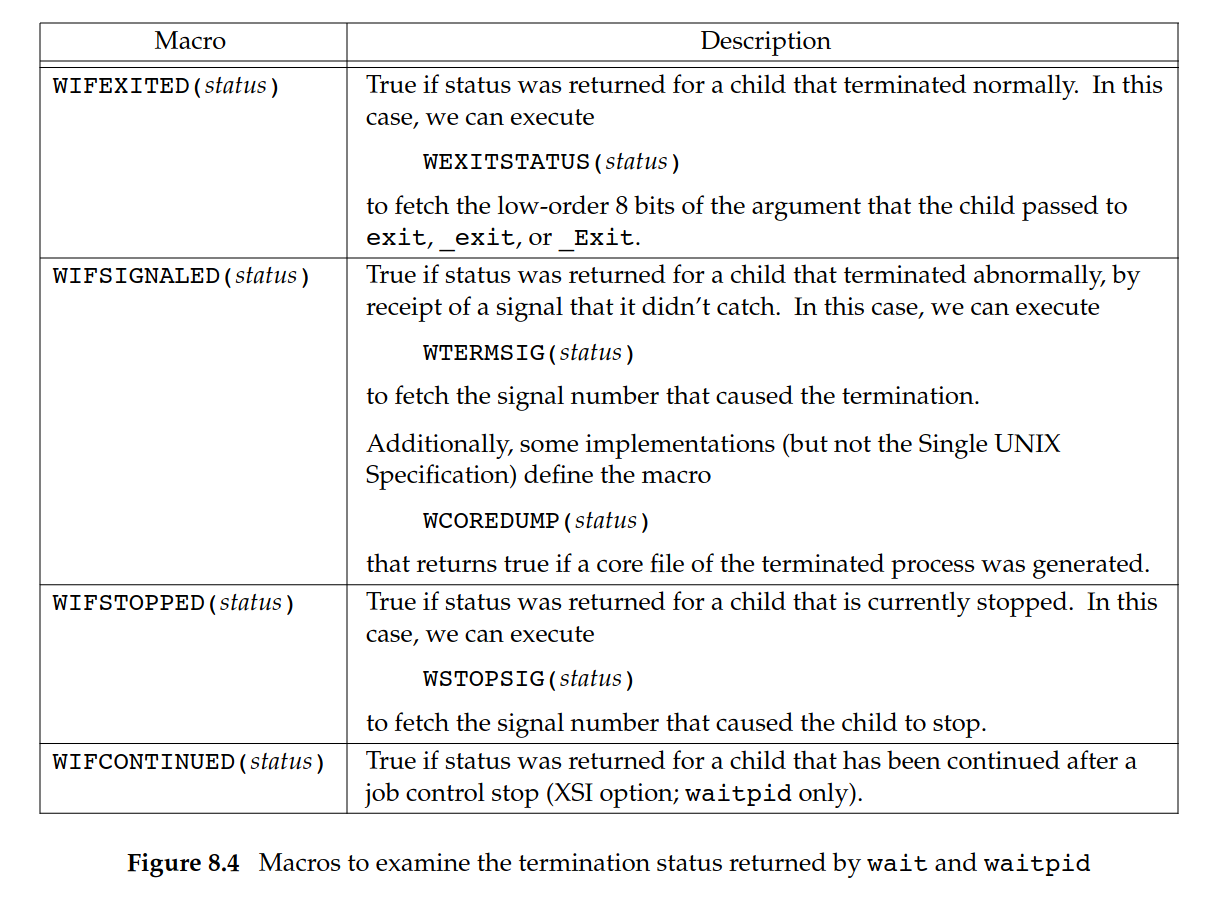
舉例:
int main() {
    pid_t pid = fork();
    if (pid < 0) {
        perror("fork");
    } else if (pid == 0) {
        printf("do some heavy work here... ");
        sleep(2);
        printf("heavy work done.\n");
        return 123;
    } else {
        int stat;
        if (wait(&stat) != pid) perror("wait");
        if (WIFEXITED(stat)) {
            printf("child returned %d.\n", WEXITSTATUS(stat));
        } else {
            printf("child terminated unexpectedly.\n");
        }
    }
    return 0;
}
輸出:
$ gcc wait.c && ./a.out
do some heavy work here... heavy work done.
child returned 123.
Zombie Process & Orphan Process
child 執行完後,因為 wait 需要獲取 child 的終止資訊,所以系統會保留 child 的 PID 、狀態訊息等,並釋放 child 在執行時間的所有資源,之後 child 會留在系統的進程列表上,且不佔用任何 CPU 資源。在 wait 執行後,系統才會把 child 的資訊從進程列表上刪除。
也就是說,如果 parent 不執行 wait ,那麼 child 會一直留在進程列表上,佔用一個 PID 值,此時 child 稱為 Zombie Process。
因此,如果一個系統內的 Zombie Process 太多(那是挺多的),會導致程式無法創造新的進程。
可以用 ps aux | grep 'Z' 找出所有 Zombie Process:
$ ps aux | grep 'Z'
USER         PID %CPU %MEM    VSZ   RSS TTY      STAT START   TIME COMMAND
admin      18128  0.0  0.0   9316  2580 pts/0    S+   17:11   0:00 grep --color=auto Z
如果 child 還沒執行完,parent 就已經終止了,那麼 child 會失去它的 parent,此時 child 稱為 Orphan Process。接著系統會把 child 的 parent 設為 Init 這個 process, Init 會呼叫 wait 來正常回收 child,所以 child 不會變成 zombie process。
Init 是 Unix 系統啟動後,由核心建立的第一個進程,傳統上 PID 為 1, 它負責啟動並管理系統中的其他服務與進程。
如果 child 執行完了,parent 不呼叫 wait,且 parent 也結束了,此時 child 會變成 orphan process ,然後被 Init 回收,所以 child 不會變成 zombie process。
傳統上會利用 double fork 來建立 daemon,並避免 zombie process:
pid_t pid = fork(); // parent -> child
if (pid < 0) perror("fork");
if (pid == 0) {
    pid_t daemon = fork(); // parent -> child -> grandchild
    if (daemon < 0) perror("daemon fork");
    if (daemon > 0) exit(0); // parent -> child(x) -> grandchild

    // daemon task here...
    exit(0);
}

if (waitpid(pid, NULL, 0) != pid) perror("waitpid"); // wait for child

// parent task continue...
exit(0);
此時 child 建立的 grandchild,也就是 daemon ,因為 child 結束了所以變成 orphan process,被 Init 接管後會自動呼叫 wait ,所以沒有 zombie process 的問題,而 parent 也可以繼續執行工作不需要被 wait 卡著。
現在 Linux 有 systemd(也就是 Init) 來管理 daemon 服務,所以不需要自己作 fork。
Inter-Process Communication
Inter-Process Communication(簡稱 IPC),是用來專門給多個進程間互相溝通的通道,常用的 IPC 方式有:
- Pipes
- FIFOs
- Stream Pipes
- Message Queues
- Semaphores
- Shared Memory
- Sockets
- Streams
Pipe & FIFO
#include <unistd.h>
// Returns 0 if OK, -1 on error
int pipe(int fd[2]);
呼叫 pipe 後,會在 Kernal Space 開一個 buffer,並開啟兩個 FD:fd[0] 與 fd[1]。fd[0] 是讀取 buffer, fd[1] 是寫入的 buffer 用的,兩者的檔案類型都是 FIFO。
注意, Pipe 只能用在有相同祖先的進程之間,也就是說,Pipe 只能從父進程繼承過來使用。
因為只能從 fd[0] 讀取、fd[1] 寫入,所以也被叫做半雙向(half duplex)通道,形象化的稱為 Pipe,類比圖:
在 fork 之後,因為 fd[0] 與 fd[1] 是 File Descriptor,所以會被複製。因此,在 child 中可以讀取 fd[0] 來存取 parent 在 fd[1] 寫入的訊息: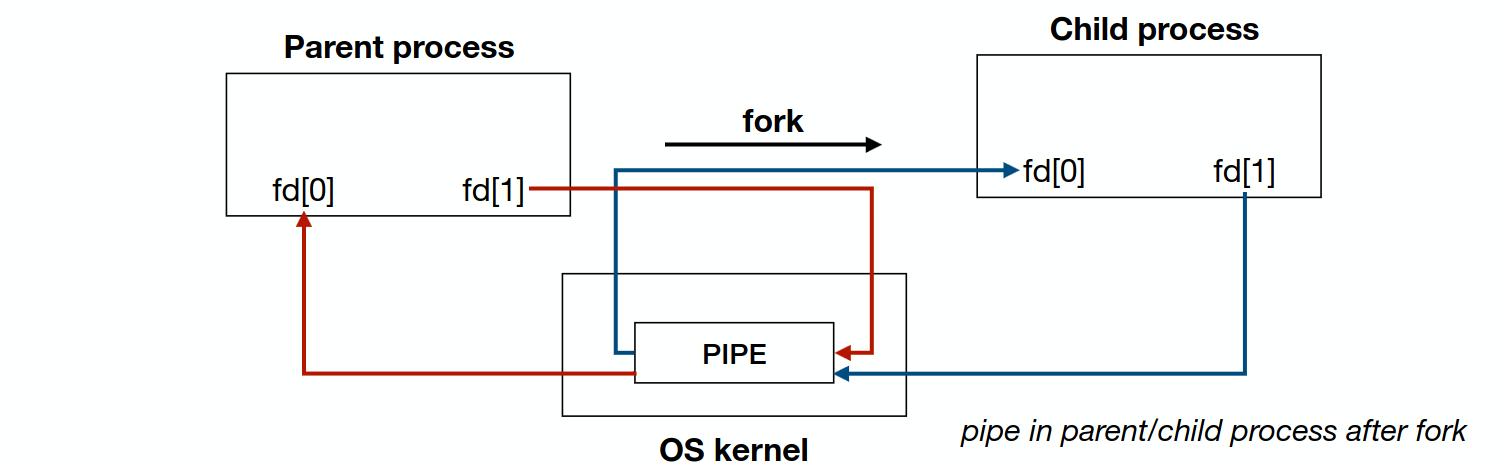
來源:SP2026Fall sp07-proc-control.pdf
因為 child 不會需要寫入訊息,所以可以把 fd[1] 關閉。而 parent 不需要讀取訊息,所以可以把 fd[0] 關閉。
因為此時 child 與 parent 複製 FD 後,兩者 fd[0] 與 fd[1] 雖然是相同數字,不過卻是兩個指標指向同一個 File Description,所以關閉其中一方的 FD 不會導致整個通道關閉: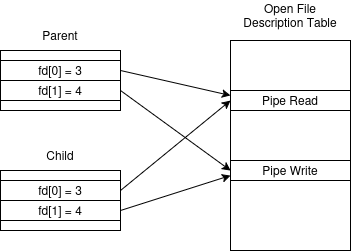
舉例:
char msg[] = "hello from parent";
int main() {
    int fd[2];
    if (pipe(fd) < 0) perror("pipe");

    pid_t pid = fork();
    if (pid < 0) perror("fork");

    if (pid > 0) {
	    close(fd[0]);
	    write(fd[1], msg, sizeof(msg));
	    wait(NULL);
    } else {
        close(fd[1]);
        char buf[128];
        int n = read(fd[0], buf, sizeof(buf));
        printf("child received: %s\n", buf);
    }
}
輸出:
$ gcc pipe.c && ./a.out
child received: hello from parent
Pipe IO 操作的行為會根據有沒有另一端而有所不同:
| Reader/Writer | read 結果 | write 結果 |
|---|---|---|
| 有 Reader 有 Writer | 有資料就讀,沒資料就阻塞 | 有空間就寫,空間滿時阻塞 |
| 有 Reader 沒 Writer | 有資料就讀,沒資料回傳 0(EOF) | X |
| 沒 Reader 有 Writer | X | 觸發 SIGPIPE,寫入進程異常中止,errno=EPIPE |
| 沒 Reader 沒 Writer | Pipe 關閉 | Pipe 關閉 |
開啟 O_NONBLOCK 後行為也會改變:
| Reader/Writer | read 結果 | write 結果 |
|---|---|---|
| 有 Reader 有 Writer | 沒資料回傳 EAGAIN | 空間滿時可能 EAGAIN 或部份寫入 |
| 有 Reader 沒 Writer | 有資料就讀,沒資料回傳 0(EOF) | X |
| 沒 Reader 有 Writer | X | 觸發 SIGPIPE |
| 沒 Reader 沒 Writer | Pipe 關閉 | Pipe 關閉 |
如果嘗試寫入超過 PIPE_BUF 大小的數據,那寫入的數據可能會跟其他寫入的數據混合(有空間時多筆寫入會競爭);如果寫入的數據小於等於 PIPE_BUF ,那保證寫入的數據是一塊連在一起的(Atomic Operation)。
要避免數據混合,就要避免寫入超過 PIPE_BUF 大小的數據,或者將一串數據拆成兩個 Pipe 來傳輸,舉例:
int command_pipe[2];
int data_pipe[2];
pipe(command_pipe);
pipe(data_pipe);

//ensure the data/cmd sent is < PIPE_BUF
void write_command(const char *cmd) {
    write(command_pipe[1], cmd, strlen(cmd));
}
void write_data(const void *data, size_t len) {
    write(data_pipe[1], data, len);
}
FIFO 其實就是有路徑的 Pipes(Named Pipes),與 Pipe 不同的是,FIFO 可以透過路徑存取:
#include <sys/types.h>
#include <sys/stat.h>
// Returns 0 if OK, -1 on error
int mkfifo(const char *path, mode_t mode);
path 是 FIFO 的路徑,mode 是 FIFO 的檔案權限,mode 一定要包含 Read/Write。
FIFO 的好處是,他不只有相同祖先的進程可以使用,只要知道該 FIFO 路徑的進程都可以使用 open/read/write 來操作。
與 Pipe 一樣,FIFO 的 buffer 是存在 Kernel Space 的記憶體中,所以 FIFO 檔案實際上不儲存內容到硬碟。
FIFO 的其他行為與 Pipe 一樣:
- 如果目前 buffer 沒有東西可以讀取,那
read(fd[0], ...)會卡著直到有人寫入fd[1]。相反地,如果 buffer 滿了(常數PIPE_BUF通常設為 4KB),write(fd[1], ...)也會卡著直到有人讀取fd[0]。可以設定O_NONBLOCK。 - 如果 parent 與 child 都關閉
fd[1],那嘗試讀取fd[0]會讀到 EOF;如果 parent 與 child 都關閉fd[0],那嘗試寫入fd[1]會導致SIGPIPE發生,寫入的進程異常終止。 - 如果嘗試寫入超過
PIPE_BUF大小的數據,那寫入的數據可能會跟其他寫入的數據混合;如果寫入的數據小於等於PIPE_BUF,那保證寫入的數據是一塊連在一起的(Atomic Operation)。
比較特殊的是, 在使用 open 開啟 FIFO 時,讀取端會等待寫入端開啟、寫入端會等待讀取端開啟,同時,有沒有設定 O_NONBLOCK 也會有區別:
| 開啟方式 | 沒有對應的另一端時 |
|---|---|
open(FIFO, O_RDONLY) | 阻塞等待 Writer |
open(FIFO, O_WRONLY) | 阻塞等待 Reader |
open(FIFO, O_RDONLY | O_NONBLOCK) | 立即成功 |
open(FIFO, O_WRONLY | O_NONBLOCK) | 立即失敗,回傳 -1, errno = ENXIO |
舉例:
// writer
int main() {
    char fifo_path[] = "/tmp/my_fifo";
    char message[] = "Hello World!";
    mode_t fifo_mode = S_IRUSR | S_IWUSR | S_IRGRP | S_IWGRP | S_IROTH | S_IWOTH;
    mkfifo(fifo_path, fifo_mode);
    printf("Waiting for a reader to join...\n");
    int fd = open(fifo_path, O_WRONLY);
    write(fd, message, sizeof(message));
    printf("Sent: %s\n", message);
    close(fd);
    return 0;
}
// reader
int main() {
    char fifo_path[] = "/tmp/my_fifo";
    char buf[128];
    printf("Waiting for a writer to join...\n");
    int fd = open(fifo_path, O_RDONLY);
    read(fd, buf, sizeof(buf));
    printf("Received: %s\n", buf);
    close(fd);
    return 0;
}
因為 FIFO 開啟會有互相等待的行為,所以可以在 open 成功後立刻移除 FIFO 的路徑,也不會造成 FIFO 失效:
// writer
int main() {
    ...
    printf("Waiting for a reader to join...\n");
    int fd = open(fifo_path, O_WRONLY);
    unlink(fifo_path);
    write(fd, message, sizeof(message));
    ...
}
Synchronization
因為 Pipe 有沒有寫入會卡著讀取端的特性,所以可以利用 Pipe 來同步兩個進程的執行順序:
int main() {
    int fd[2];
    if (pipe(fd) < 0) perror("pipe");

    pid_t pid = fork();
    if (pid < 0) perror("fork");

    if (pid == 0) {
        close(fd[1]);

        printf("waiting for parent...\n");
        char buf[16];
        read(fd[0], buf, sizeof(buf));

        printf("child job here...\n");
        return 0;
    }

    close(fd[0]);

    printf("parent job here...\n");
    sleep(2);

    char sig[] = "ok";
    write(fd[1], sig, sizeof(sig));

    wait(NULL);
    printf("all job done.\n");
}
輸出:
$ gcc sync.c && ./a.out
parent job here...
waiting for parent... // wait for 2 seconds
child job here...
all job done.
如果兩者需要互相等待,那麼就可以開兩個 Pipe ,舉例來說讓 parent 與 child 同時退出:
int pfd1[2], pfd2[2];
bool init_pipes() {
    return pipe(pfd1) == 0 && pipe(pfd2) == 0;
}
void wait_parent() {
	char buf[16];
    read(pfd1[0], buf, sizeof(buf));
}
void tell_parent() {
    char msg[] = "ok";
    write(pfd2[1], msg, sizeof(msg));
}
void wait_child() {
    char buf[16];
    read(pfd2[0], buf, sizeof(buf));
}
void tell_child() {
    char msg[] = "ok";
    write(pfd1[1], msg, sizeof(msg));
}

int main() {
    if (!init_pipes()) perror("pipe");
	pid_t pid = fork();
	if (pid < 0) perror("fork");

	if (pid == 0) {
	    printf("child job here...\n");
	    sleep(3);
	    printf("child done...\n");
	    tell_parent();
	    wait_parent();
	    return 0;
	}

	printf("parent job here...\n");
	sleep(3);
	printf("parent done...\n");
	tell_child();
	wait_child();
	printf("all done.\n");
	return 0;
}
輸出:
$ gcc wait2.c && ./a.out
parent job here...
child job here...
parent done...
child done...
all done.
所以可以用 Pipe 來解 Race Condition,但蠻蠢的。
考慮以下程式:
int main(void) {
    if (fork() == 0) {
	    int pfd[2];
	    pipe(pfd);
	    if (fork() == 0) {
	        close(pfd[1]);
	        char buf[128];
	        read(pfd[0], buf, sizeof(buf));
	        close(pfd[0]);

	        // daemon job...
	    }
	    close(pfd[0]);
	    char msg[] = "Ok";
	    write(pfd[1], msg, sizeof(msg));
	    close(pfd[1]);
	    exit(0);
    }
    wait(NULL);
}
這個程式的作用是讓 grandchild 等 child 結束再開始執行,但是 grandchild 接收到消息的那一刻不代表 child 真的結束了,因為有可能在接收完訊息後,CPU 讓 grandchild 開始執行,而不去執行 child 的 exit(0),所以 child 實際上還沒結束。
一個解決辦法就是讓 parent 與 grandchild 通訊,讓 parent 在 wait(NULL) 結束後再發送訊息給 grandchild。
同步處理有個重要的問題叫做 Deadlock(死鎖),是當多個工作都必須互相等待對方完成才能執行時,無限互相等待的迴圈。(a situation wherein two or more competing actions are waiting for the other to finish, and thus neither ever does.)
前面的 code 不會產生 deadlock 的原因是,雙方的工作是在等待對方之前就已經完成,而 Deadlock 是因為在等待之後才能完成。
以 vfork 來舉例:
int var = 10;
int main() {
    pid_t pid = vfork();
    if (pid < 0) perror("vfork");
    if (pid == 0) {
        while (var < 20) sleep(1);
        _exit(0);
    }
    var += 100;
    return 0;
}
因為 vfork 會卡著父進程,而子進程又必須等待 var >= 20 才能繼續執行,所以屬於雙方互卡的操作,死機了。解決 Deadlock 的辦法就是定義好程式的行為,搞清楚誰該先等待,或者使用其他機制,從編寫時就避免掉。
一段(File IO & Process)的 Cheatsheet:SP-Midterm-Cheatsheet ,每頁 4 面可以壓到 2 頁以下。